
How studying a Wits Postgrad Diploma in Public Management online works
Learn what to expect when studying a Postgrad Diploma in Public Management online, including support, weekly workload and tips to succeed while working.
Read More

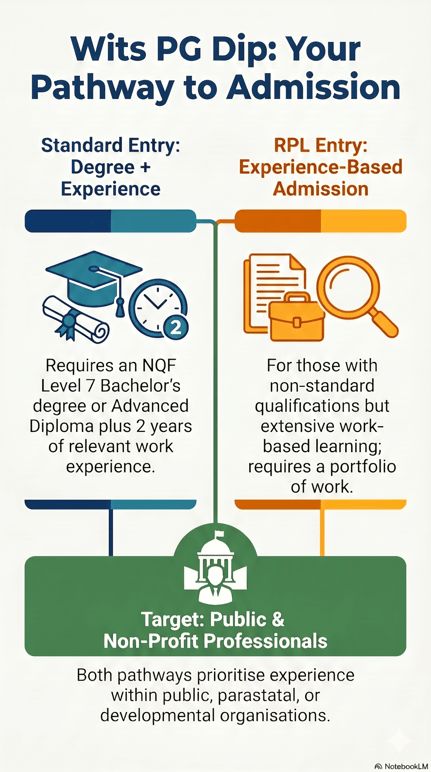
The shift toward evidence-based governance in sub-Saharan Africa has elevated the strategic importance of monitoring and evaluation (M&E) as a core public-sector capability. The University of the Witwatersrand offers the fully online Postgraduate Diploma in Public Management in the field of Monitoring and Evaluation to address this demand. This NQF Level 8 qualification provides a robust mechanism for mid-level and senior public managers, parastatal officials, and non-profit leaders to transition into highly strategic oversight roles. Operating on a part-time cycle, the fully online delivery allows working professionals to balance demanding operational responsibilities with rigorous academic advancement. In this article, we will cover the various entry requirements and pathways to qualify for placement in this competitive programme.
The entry criteria for the Postgraduate Diploma in Public Management in the field of Monitoring and Evaluation reflect a deliberate focus on the flexible needs of practising professionals. The School of Governance adopts a broad, multi-disciplinary approach to build a highly diverse, collaborative learning cohort.
The core admission requirements for the online programme include:
This multi-disciplinary approach allows the School of Governance to draw experts from technical fields such as engineering, healthcare, and finance, transforming these specialists into agile public leaders who can manage public resources through the lens of M&E.
For experienced professionals who fall outside the standard academic boundaries, the Recognition of Prior Learning (RPL) policy offers a legitimate alternative entry point. Candidates can be assessed on their experiential and work-based learning to determine whether their professional competencies align with the cognitive and analytical capacities of a standard graduate. If the admissions committee identifies potential in a candidate who lacks certain foundational skills, the university may require the completion of preliminary bridging modules before formal admission is approved.
Once admitted, the academic demands are structured to ensure professional competence, maintaining a pass mark of 50% for each of the eight modules. Crucially, the diploma acts as an important articulation pathway; students who achieve an average mark of 65% or higher across their modules may satisfy the primary academic requirements to proceed directly to a Master’s degree, providing a vertical progression route for career-driven scholars.
To ensure a seamless evaluation process, candidates must upload a comprehensive and meticulously certified portfolio of supporting documents through the online application portal. Incomplete portfolios cannot be referred to the academic school for selection, which may result in missing the desired intake window.
The required components of the online application portfolio include:
All copies of original certificates and transcripts must be formally certified by a Commissioner of Oaths or a Notary Public within the three months prior to submission. The certifier's stamp must clearly state the date, name, and designation, and it must not obscure any text on the document. Only high-resolution, clear PDF scans are accepted, while photographed documents are rejected.
If you would like to find out more about the Postgraduate Diploma in Public Management in the field of Monitoring and Evaluation programme, you can also read the following articles:
Yes, candidates without a formal NQF Level 7 qualification can apply through the Recognition of Prior Learning (RPL) process. Applications are evaluated on a case-by-case basis to assess whether the applicant’s professional history and work-based learning reflect the required cognitive skills. Under RPL guidelines, the candidate may be required to complete preliminary bridging programmes to confirm their academic readiness.
Every academic transcript, graduation certificate, and identification document must be certified by a Commissioner of Oaths or a Public Notary within three months of application. The certification stamp must display the date, name, designation and signature of the officer without obscuring any text. Documents must be uploaded as high-quality, clear PDF files. Blurred files or low-resolution photographs will be rejected, delaying the evaluation process.
No, a tablet, netbook or Chromebook is not suitable as a primary study device. While they can be used for casual reading and accessing discussion posts on the go, major assignments and quantitative modules require a standard computer. Key assessment tools and data analysis software are often incompatible with mobile operating systems and lightweight processors, making a standard Windows PC or macOS laptop essential.
Students are only required to pay for one module at a time, allowing them to space out the financial commitment over eight separate payments. Self-funded students are required to pay their course fees upfront per intake module. Because tuition fees increase annually in January, sponsored or employer-funded students are advised to obtain two separate quotations for each year of enrolment to avoid funding shortfalls.
The programme is delivered fully online and runs a part-time cycle consisting of eight modules, with each module running over an intensive seven-week period followed by a one-week break. The structure is asynchronous, meaning there are no mandatory "live" lecture times during work hours; you can access lectures, readings, and discussion forums 24/7. However, students must be prepared to commit 15 to 20 hours per week to keep up with assignments and meet fixed weekly discussion deadlines.
Wits.
For Good.


Learn what to expect when studying a Postgrad Diploma in Public Management online, including support, weekly workload and tips to succeed while working.
Read More
A practical guide to applying for an online Postgraduate Diploma in Public Management: steps, documents, timelines and what happens after you submit.
Read More
Understand the entry requirements for a Postgrad Diploma in Public Management, what you may need to apply and how to check if you qualify for online study.
Read MoreWits. For Good.